


Novexx XPA 9xx print & apply systems
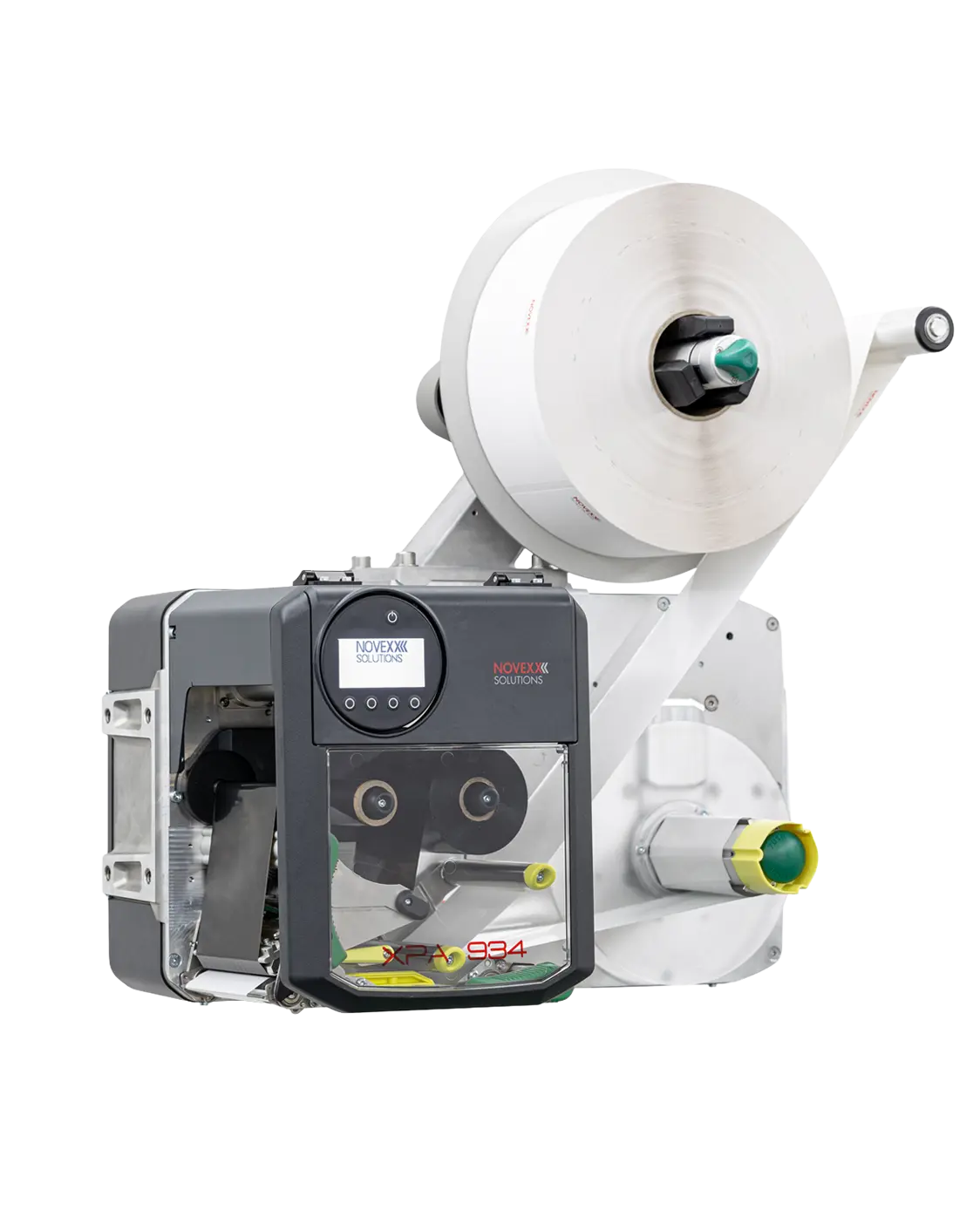
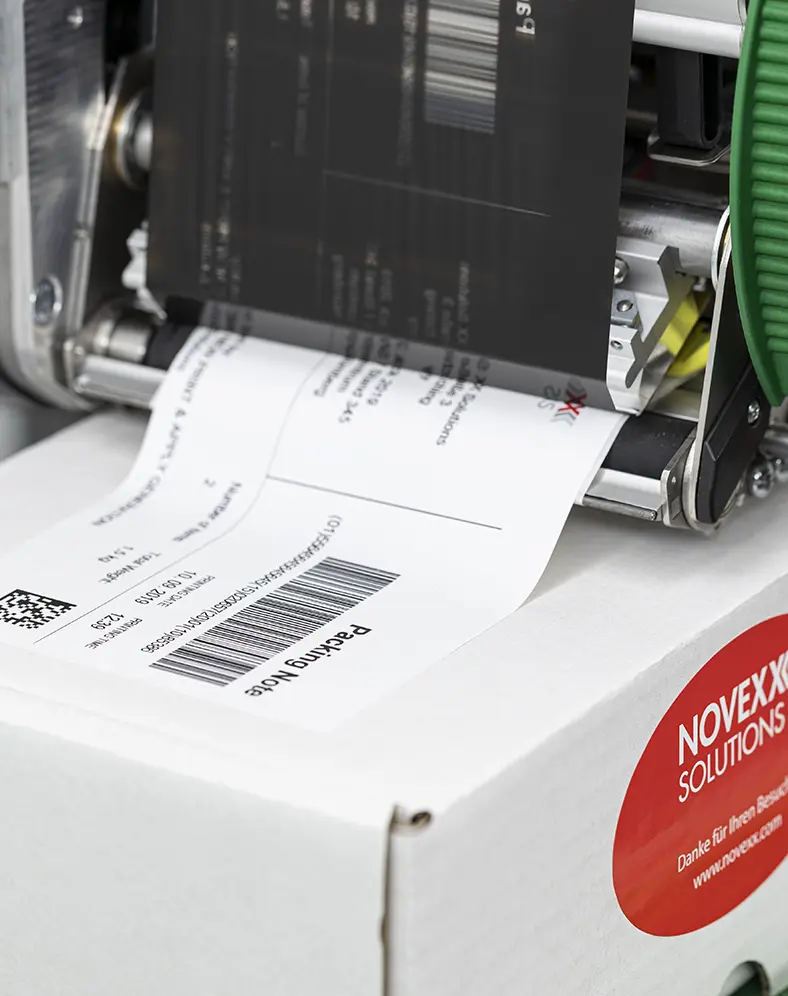
The NOVEXX XPA 9xx prints variable-data labels and applies them to products on the production line. Each label can contain a different serial number, weight, destination or GS1 logistics code. The range offers direct thermal and thermal transfer printing at 300 dpi, with print widths of 106, 127 or 160 mm. The fastest model, the XPA 944, reaches a print speed of 400 mm/s. Actual labelling throughput also depends on label length and the applicator cycle.
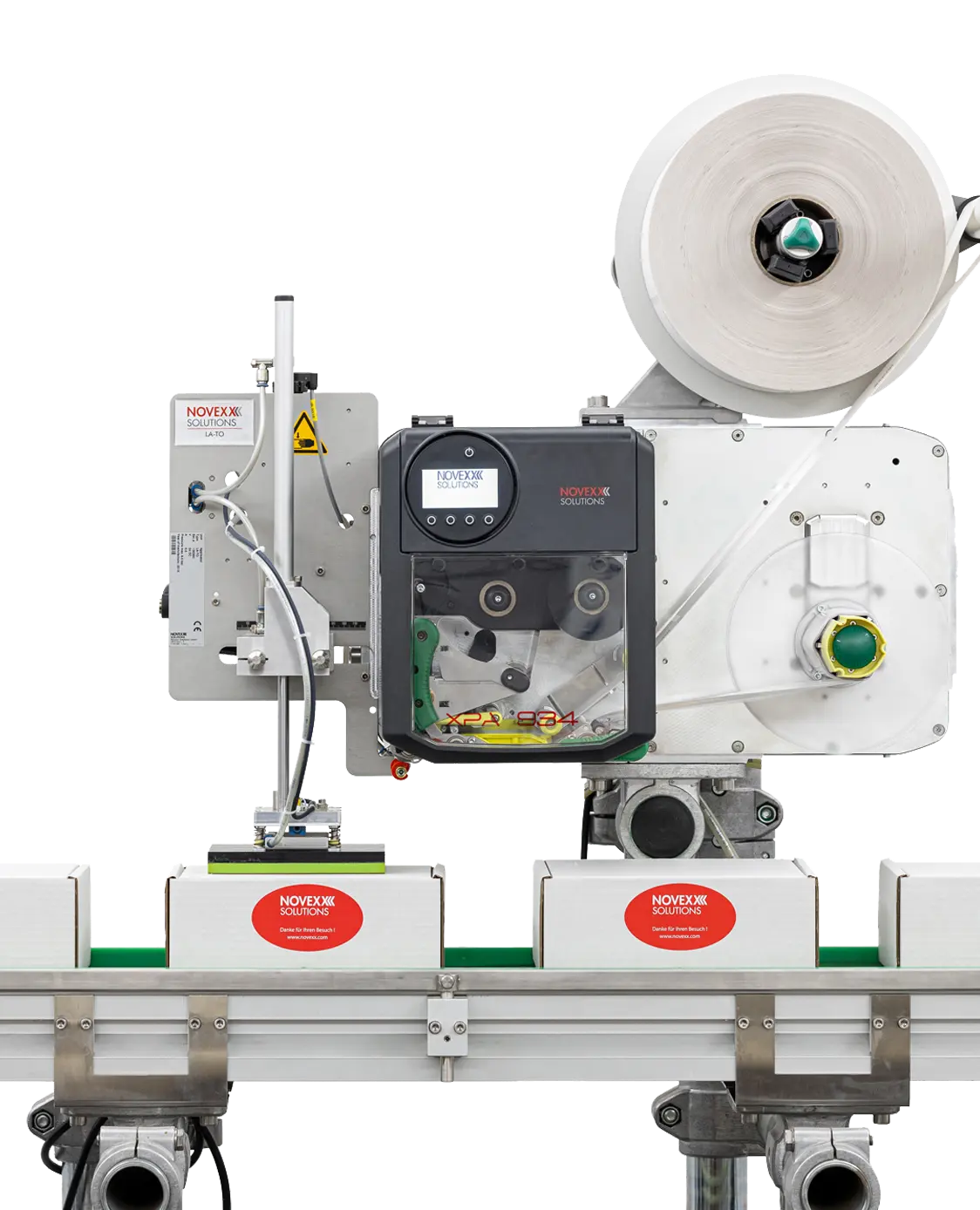
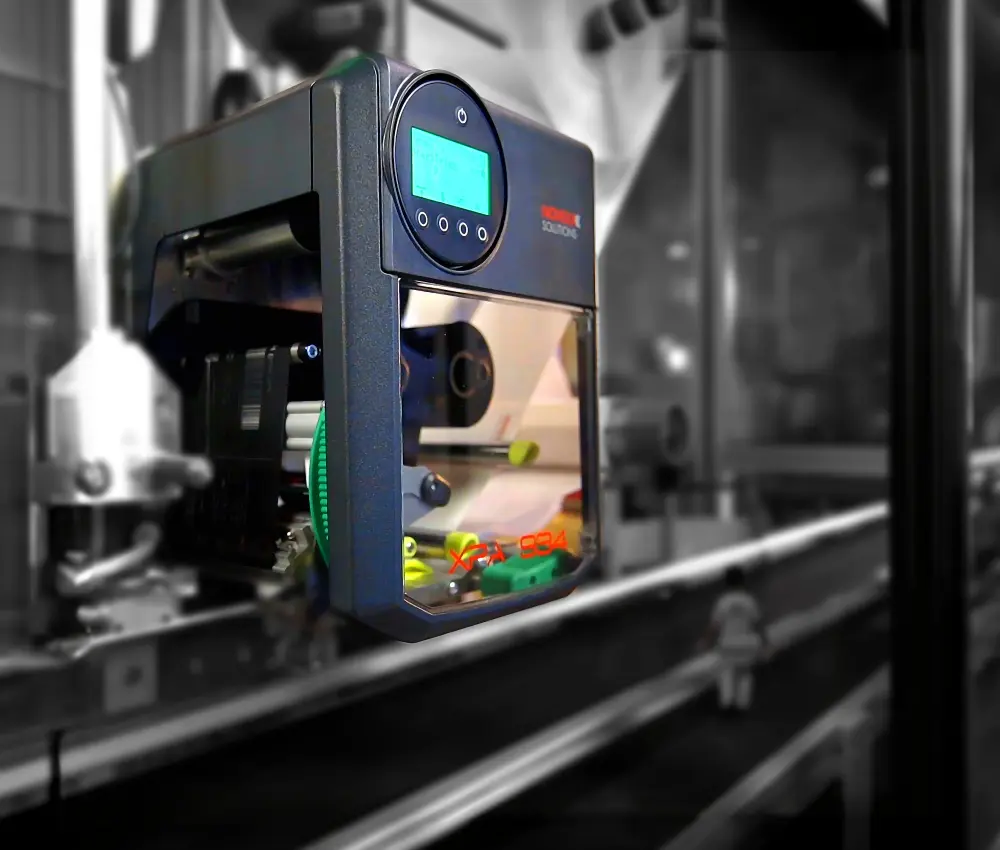
The XPA 9xx combines a compact design with flexible installation. It can be mounted above, beside or below a conveyor, with left- and right-hand versions available. The 4-inch models weigh 27 kg, while a rotatable display remains accessible in different mounting positions. Routine maintenance and the replacement of wear parts, including the printhead and silicone rollers, can be carried out without tools. A web interface provides access to settings and diagnostics. The system is designed and manufactured in Germany and is supplied with a two-year manufacturer warranty, subject to the applicable terms.
Print variable labels directly on the line
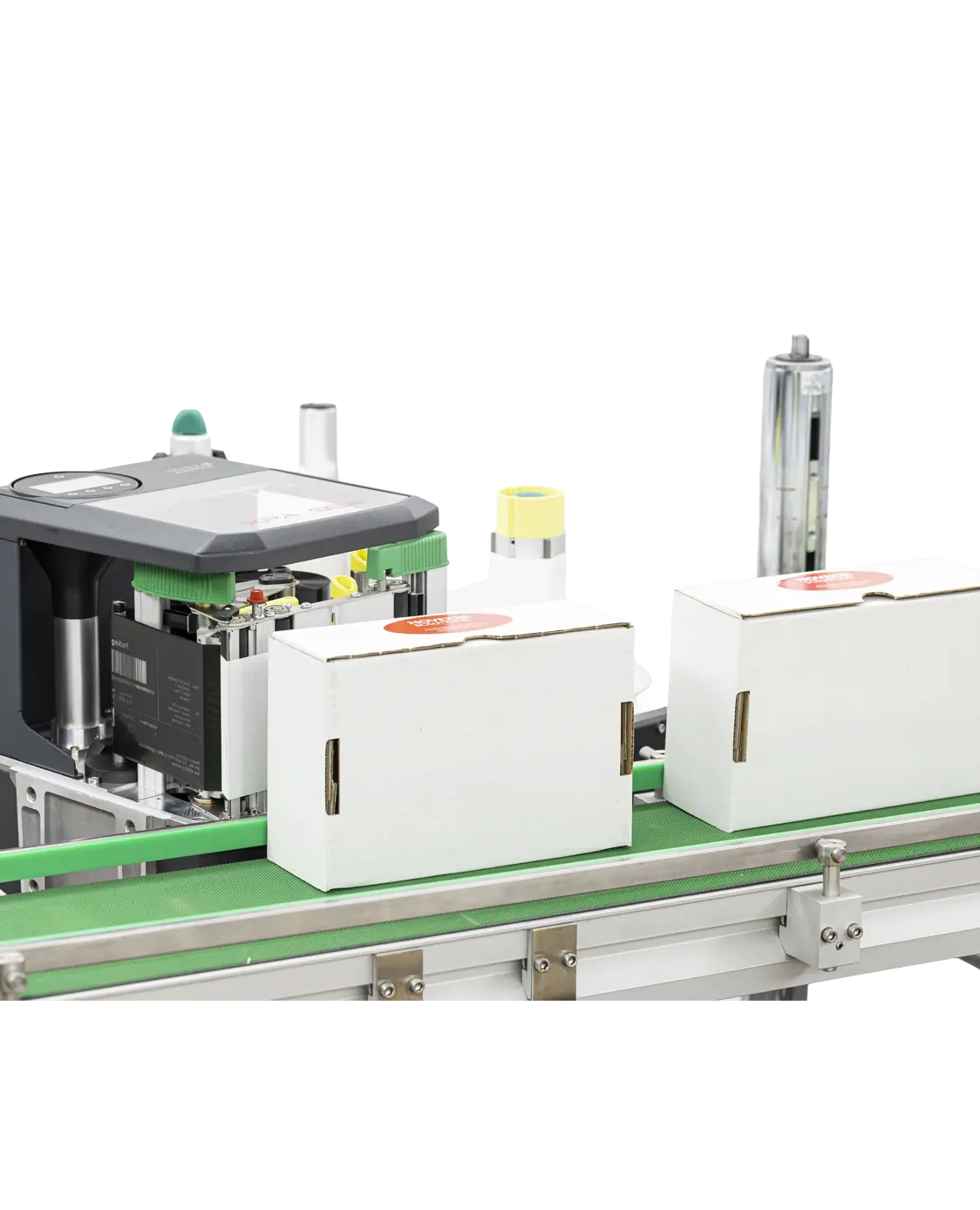
Conventional labellers apply labels printed in advance. That is efficient when the same design is used repeatedly, but serial numbers, shipping addresses and variable weights often need to be generated for individual products. Printing these labels separately and applying them by hand adds another step and increases the risk of errors. A print-and-apply system receives the required data from the connected software, prints the label and applies it on the line. This reduces manual handling and the need to store pre-printed variable-data labels. Successful operation still depends on correct data, product detection and system integration.
Key features of the XPA 9xx
It fits where there is no room
The compact XPA 9xx is designed for installation on existing production lines. The 4-inch XPA 934 and XPA 944 weigh 27 kg each, with left- and right-hand versions and flexible mounting positions. The installation layout and choice of applicator determine the space required.
A display that turns to face you
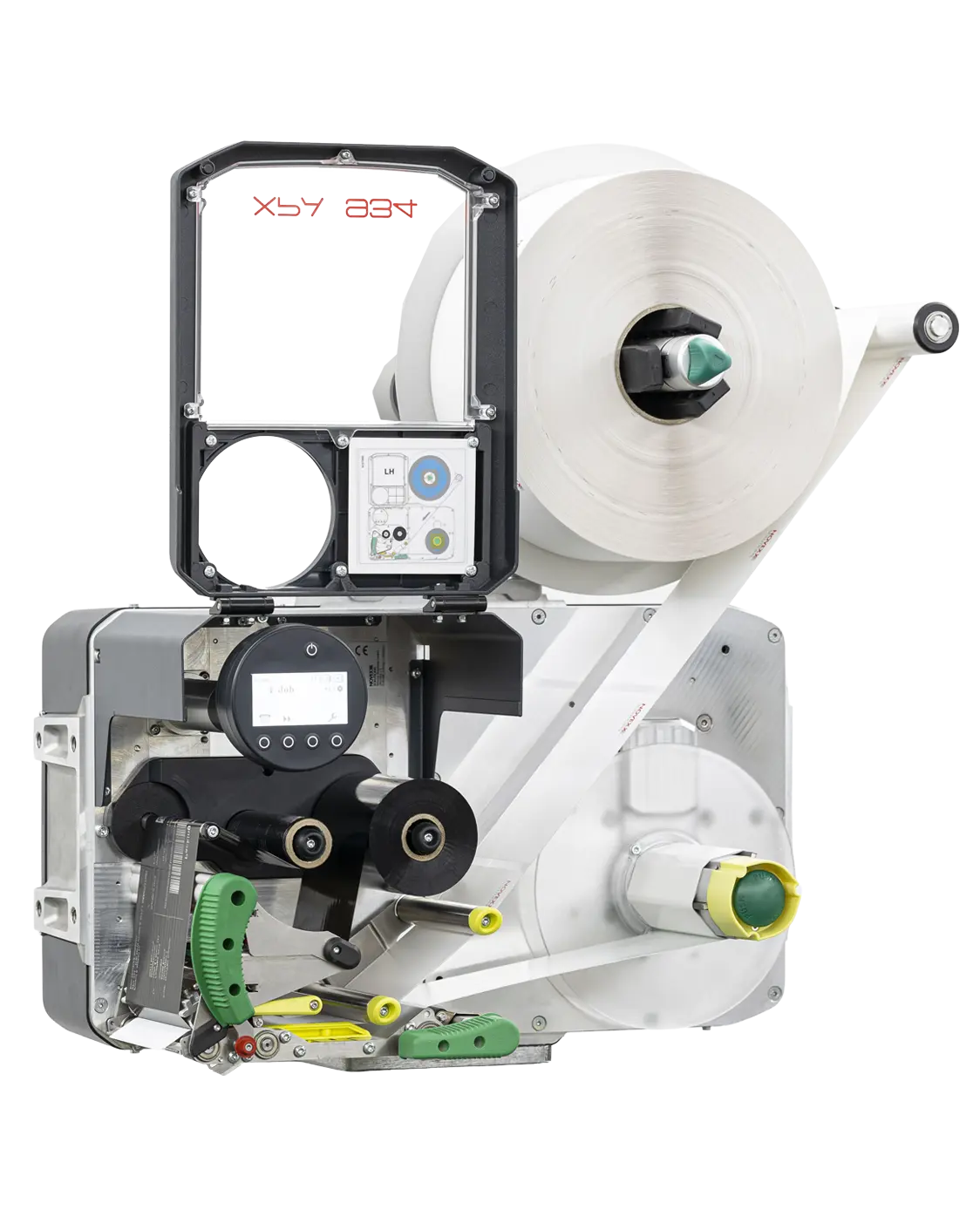
The high-contrast display has a multi-colour backlight and can be rotated to suit the installation. Its four physical buttons remain accessible with the cover open or closed, including when operators wear gloves.
100% tool-free maintenance
The open print module provides access for routine cleaning and replacement of wear parts, including the printhead and silicone rollers, without tools. Automated adjustment functions help maintain consistent print quality after material changes.
Material changes in seconds
An accessible print module simplifies loading labels and thermal transfer ribbon. Ribbon capacity is specified at up to 1,100 m, depending on the approved ribbon and configuration, reducing the frequency of changes during longer production runs.
Settings that set themselves
Automatic control of ribbon tension and printhead settings reduces the number of manual adjustments needed. This helps operators maintain consistent results when changing materials or moving between production shifts.
Web interface and M12 I/O
The web interface supports remote configuration, diagnostics and status monitoring. Standard connections include Gigabit Ethernet, RS-232 and USB. Configurable M12 I/O interfaces support line signals, with additional I/O and conveyor-speed tracking available through optional hardware.
Technical specifications
These specifications refer to the XPA 944, the fastest model in the range. The four models differ in print width, material width and speed. Check the comparison below, then select an applicator for your product, label dimensions and available line space.
- Print width: 106 mm (4")
- Resolution: 300 dpi
- Print speed: 75–400 mm/s
- Label roll: Up to 300 mm on 76.2 mm core
- Dimensions (H×W×L): 639 × 546 × 363 mm
- Weight: 27 kg
Six ways to place the label
The applicator determines how the newly printed label reaches the product. NOVEXX offers several application methods, but compatibility and achievable throughput depend on the chosen model, label and installation.
Linear
A pneumatic applicator moves a pad towards the product to press a label onto a surface. It is commonly used for firm, flat cartons and cases where the application distance is predictable.
Blow-on
A jet of compressed air transfers the label without the applicator touching the product. This can suit delicate or irregular packaging, subject to label size, distance and air-supply requirements.
Corner edge
A corner-edge applicator wraps a label across two adjoining surfaces. It can be used for corner identification and tamper-evident seals when the label material and pack dimensions are suitable.
Swing
A swing applicator moves through an arc to reach the application surface. It is useful where the available mounting position or product geometry calls for an angled approach.
Pallet
A pallet applicator can place logistics labels on the required pallet faces. The XPA 936 is used in NOVEXX pallet-labelling configurations; the number of sides and GS1 compliance depend on the specified applicator, label format and installation.
Airless
An electrically operated applicator can apply labels without a compressed-air supply. Its suitability depends on the label format, product surface and required application speed.
Which XPA model fits your line?
The range includes two 4-inch models and wider 5-inch and 6-inch versions. Choose the model using the required print width, label-material width and production cycle time. The maximum 400 mm/s print speed applies only to the XPA 944.
| Model | Print width | Label material width (incl. backing) | Print speed | Weight | Best for |
|---|---|---|---|---|---|
|
XPA 934
4" standard
|
106 mm | 20–120 mm | 75–300 mm/s | 27 kg | The default for carton, case and product labelling on standard 4-inch labels |
|
XPA 944
4" high speed
|
106 mm | 20–120 mm |
75–400 mm/s
Fastest in the range
|
27 kg | Fast conveyors and tight label pitches, where 300 mm/s would make the labeller the bottleneck |
|
XPA 935
5"
|
127 mm | 20–185 mm | 75–250 mm/s | 33 kg | Labels that overflow 4 inches — dense despatch data, larger product labels |
|
XPA 936
6"
|
160 mm | 20–185 mm | 75–250 mm/s | 33 kg | A5 and GS1 pallet labels — the model behind Novexx's integrated pallet labelling configuration |
Need help specifying a print & apply system?
Tell us what you are labelling, the label size, the conveyor speed, where the label must go and how the print data is supplied. We can help select the printer, applicator and interfaces.
Common questions about the XPA 9xx
If your labels contain the same information, they can often be printed in batches on an XLP 60x and applied using an XLS 2xx. That can be an economical approach for established designs. For variable-data labels that change from product to product, an integrated print-and-apply system can reduce manual handling, but its suitability depends on the required speed and data workflow.
Where each label contains unique data, inline printing can avoid a separate manual labelling stage. The XPA prints the label before applying it, so both print time and applicator cycle time must fit the available interval between products. The XPA 944 offers the highest print speed in this range at up to 400 mm/s, but the complete application needs to be assessed.
No. The maximum 400 mm/s print speed applies only to the XPA 944. The XPA 934 reaches 300 mm/s, while the XPA 935 and XPA 936 reach 250 mm/s. These are print speeds, not guaranteed rates of labelled packs per minute. Label length, required print quality, product spacing and applicator cycle time all affect throughput.
Match the applicator to the product and label. A linear unit suits firm, flat surfaces; blow-on applies without contact; corner-edge wraps around a corner; and swing applicators reach awkward positions. Pallet and airless options are also available. Compatibility, application speed and utilities must be checked for the exact configuration.
The XPA 9xx provides Gigabit Ethernet, RS-232 and USB interfaces. Standard M12 connections support essential line signals, while optional I/O and APSF hardware can add further connections and conveyor-speed tracking. Integration with ERP or WMS software depends on the host system, data format and print-management workflow. NOVEXX PID 3SIXTY is one available software option, and the web interface supports device configuration and diagnostics.
No. NOVEXX lists Ribbon Save as an optional feature for the XPA 9xx. When fitted, it can reduce ribbon consumption across sufficiently long unprinted areas. The amount saved varies with the label design, print speed and operating mode, so a sample layout is the best way to assess the benefit.
The XPA 9xx has an IP21 protection rating and is not intended for wash-down areas. Its specified operating range is 5–40 °C and 20–85% relative humidity without condensation. Check dusty, unheated or damp installations against the actual environmental conditions and the manufacturer's guidance.
Where only a date or batch code needs to be added to an otherwise pre-printed label, a separate thermal transfer overprinter and labeller may be appropriate. The Savema D-series with an integrated printer is another option. For fully variable labels, the XPA 9xx can print and apply each label as part of the line process. Compare the alternatives using your actual label content and production speed.
For pallets, NOVEXX offers configurations built around the XPA 936 as well as its XPU pallet-labelling system. OEM manufacturers can also consider the XDM and XPM print modules. Tell us your product, label dimensions and installation requirements so we can identify the appropriate solution.